How Many Valence Electrons Do The Noble Gases Possess
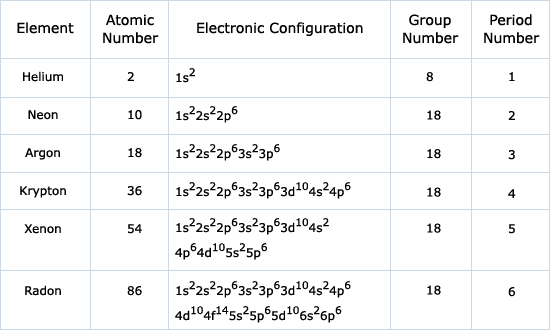
How Many Valence Electrons Do The Noble Gases Possess. So the group number is equal to the number of valence electrons. According to octet rule, stable atoms have 8 valence electrons or you can say 8 electrons in their valence shell just like the noble gases or group 18 of the modern periodic table.
Except for helium, how many electrons do noble gases have from socratic.org
Why do noble gases only have 8 valence electrons? Answer e) 8 electrons neon, like all noble. Atoms in group 7a have 7 valence electrons and gain 1 more electron to get octet.
How Many Electrons Do The Group 7A Elements Halogens Gain To Be Isoelectronic With A Noble Gas?
When filling degenerate orbitals, electrons fill them singly first, with parallel spins. A) 3s^0 b) 3s^2, d^1 c) 3s^1 d) 3s^2, d^2 e) 3s^2 e 17 which of the following statements is false? 1 how many valence electrons do the noble gases possess?
So The Group Number Is Equal To The Number Of Valence Electrons.
And so we can say that for main groups, if you want to figure out how many valence electrons you have, it's just equal to the group number. How many valence electrons do the noble gases possess in the second period and below in the periodic table? According to octet rule, stable atoms have 8 valence electrons or you can say 8 electrons in their valence shell just like the noble gases or group 18 of the modern periodic table.
*Outer Electrons Efficiently Shield One Another From Nuclear Charge.
Answer e) 8 electrons neon, like all noble. But for most of the transition and inner transition elements, the valence electrons are the electrons present in the shells outside the noble gas core. As a result, the oxygen atom completes its octave and acquires the electron configuration of neon.
How Many Valence Electrons Do The Noble Gases Possess In The Second Period And Below In The Periodic Table?
This is known as (the) hund's rule. (2) the formula for the compound sodium carbonate contains parenthesis. So that means that sodium has one valence electron.
A) N = 3, L = 1, Ml = 0.
Two oxygen atoms and one titanium atom make titanium dioxide (tio 2) compounds by sharing electrons. That is relatively unreactive because of its electron configuration, where the octet rule is fulfilled (the atom has eight valence electrons). They need to lose only one or two valence electrons to form positive ions with a noble gas configuration.