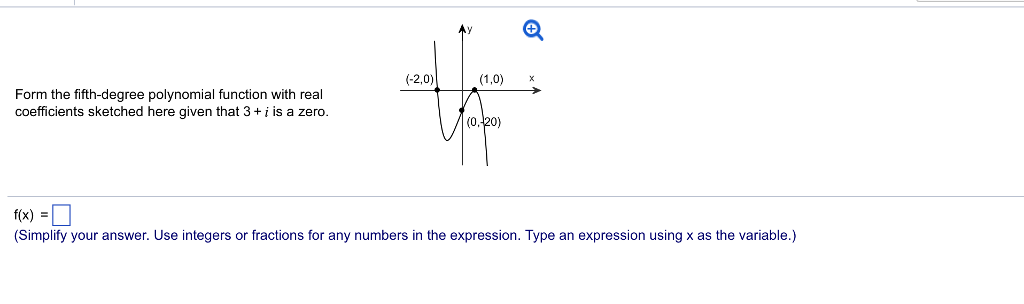
Fifth Degree Polynomial. Polynomial of the second degree. Equations of degree 5 or higher cannot be solved by radicals.
Solved Form The Fifthdegree Polynomial Function With Rea from www.chegg.com
If at least one root is conjugate or complex, then this law may be difficult. However, for roots of fifth degree polynomials, there is likely no better exact description of them than these are roots of this fifth degree polynomial. Equations of degree 5 or higher cannot be solved by radicals.
Write The Polynomial As The Product Of (X−K) And.
= (b) find the fifth degree taylor polynomial approximation t5(x) to the function f(x) = sin(x) about x = 0. Polynomial of the first degree. Thus, the degree of the polynomial will be 5.
The Fifth Degree Transcendental Polynomialin This Section, We Shall Study The Distribution Of Zeros Of A Fifth Degree Transcendental Polynomial.
In problems with many points, increasing the degree of the polynomial fit using polyfit does not always result in a better fit. If at least one root is conjugate or complex, then this law may be difficult. Polynomial of the third degree.
5X 5 +7X 3 +2X 5 +9X 2 +3+7X+4.
Note that the above construction of the galois group for a fifth degree polynomial only applies to the general polynomial, specific polynomials of the fifth degree may have different galois groups with quite different properties, e.g. Polynomial of the second degree. Calculus power series constructing a taylor series.
Equations of degree 5 or higher cannot be solved by radicals. So, 5x 5 +7x 3 +2x 5 +9x 2 +3+7x+4 = 7x 5 + 7x 3 + 9x 2 + 7x + 7. In the case of 5th degree polynomials, if it were possible to invert the polynomial x 5 − x − 1 (i.e.
So As You See, It's Just A Little Bit Too Complicated, And It Gets Worse As The Degree Increases.
Polynomial of the fourth degree. Since the degree of the polynomial is 5, we have 5 zeroes. X 5 + x 4 − 8 x 3 − 1 0 x 2 + 7 x − 4.